I’ve been an apprentice writer for nine-tenths of my life. That may leave you guessing!
What I will let slip is, aged nine, modelling myself on LM Montgomery’s teenage aspiring author Anne Shirley, I took on board ‘Write what you know’ – likely a Mark Twain maxim. I didn’t find this easy. Despite loving the novels component in my rather traditional, chronologically arranged uni English Literature syllabus, embracing Ann Radcliffe to EM Forster, and sampling more contemporary fiction in my own time, I spent my twenties convinced I didn’t have the life experience to write a novel myself. Two decades – stalled.
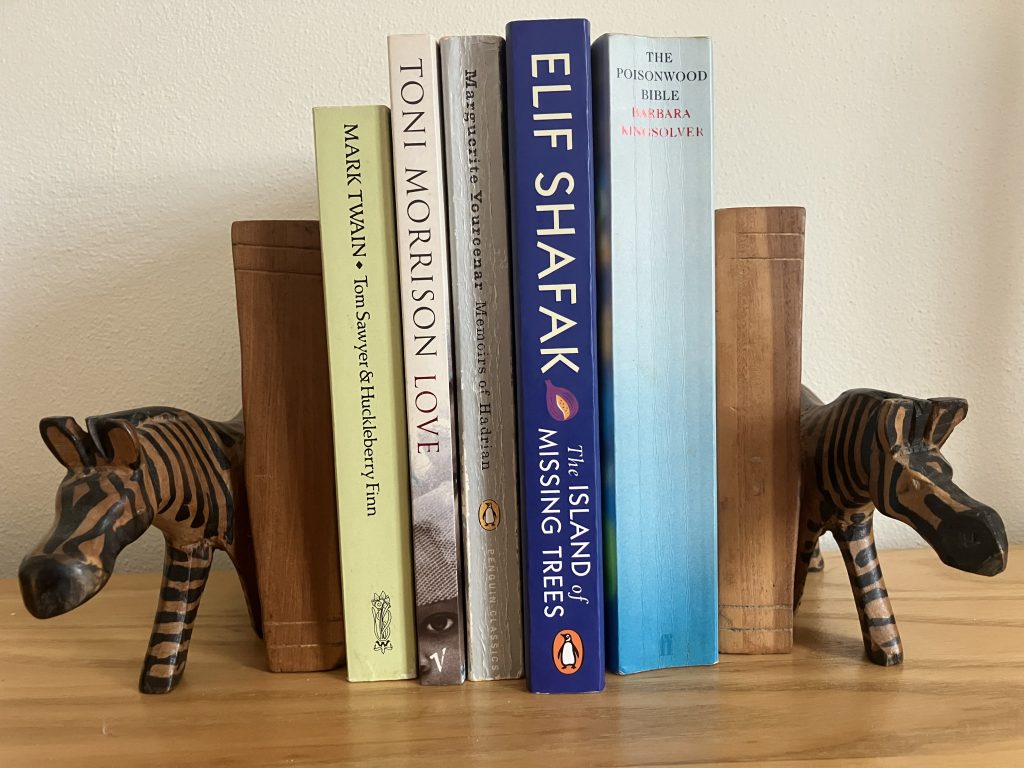
What if, at this early stage in my development, I’d encountered Nobel laureate Toni Morrison? Who, teaching creative writing at Princeton, urged her students please to do the opposite, and give free rein to their imaginations about what they didn’t know … on the intriguing basis that, ‘Even if they ended up just writing an autobiography, at least they could relate to themselves as strangers.’ Or listened sooner to British Turkish novelist Elif Shafak’s TED talk, advocating the same in order to break free of one’s own culture and politics. Both women strike me as offering an education not only in writing, but in empathy.
As it transpired, in my thirties, bearing and rearing young children, I turned to poetry – since I couldn’t get past the first few chapters when reading a novel, no time, but a poem slid down my throat like an oyster while waiting for a toddler-sized helping of cottage pie with sweet potato mash to warm in the microwave. Taking a small step further, I started writing poems, which could happen a couple of lines at a time. The process brought me joy. A noticeable trend – in them I told stories. A good number found their way into magazines.
‘Falls the Shadow’ – TS Eliot’s insight. For me, a hiatus of ten years. Why? A period of illness, a breakdown, beyond which I made rapid progress, except for the lingering false belief that I wasn’t ‘allowed’ to write, in case I hurt people. Bizarre, its origin a mystery, but true.
Followed by a breakthrough: I’d been working in the mental health sector, drawing on my own recovery to help others, with no thought of writing anything at all. Unbidden, the idea for my first novel manuscript seized me, a historical mystery that imagines a life for a twentieth century character who really existed, but disappeared, her fate unknown. Bumper to bumper came the second manuscript, this one a contemporary magical realism story, which begins with a dramatic occurrence in my own life, and develops in the opposite direction from the real-life outcome. The effect of both has been to ‘hold me hostage’ – as Richard Skinner, a British novelist who is also a creative writing course director, describes the force behind his most successful work. Each of my projects has been longlisted in separate competitions – though I’m still trying to work out how to get them over the line for publication. This is the place where I am now.
So what of the conflicting advice given by those good, or great, writers from whom I seek to learn?
The deeper question for me is, ‘What do I know, and what don’t I?’
Philosophy and science are not my disciplines, but to take just one study: ‘Neuroscience has discovered that imagination and perception rely on overlapping brain circuits,’ suggesting ‘there is no categorical difference between imagination and reality; instead it is a difference in degree, not kind.’ – Dr Nadine Dijkstra of the Wellcome Centre for Human Neuroimaging at UCL. Once in my imagination, people and places develop an independent existence of their own, and I find myself writing to discover what happens to them there. I live those other lives. Add to this, in practice I can’t write anything I don’t know, because nothing comes from nothing, and logic argues, I must hold that knowledge somewhere inside me, their creator.
Carl Jung believed dreams compensate for the parts of our psyche that are underdeveloped in our waking lives. Switch to those waking hours, and stories explore our latent possibilities in an empathic way that draws on another Jungian theory, the ‘collective unconscious’ – humanity’s shared inheritance of past experience. While a literal interpretation of this is deemed unscientific, its symbolic value remains.
Updated writing advice to self? As so often, the 13th century Persian Sufi poet Rumi encourages me: ‘Everything in the universe lies within you. Ask all from yourself.’


Leave a Reply