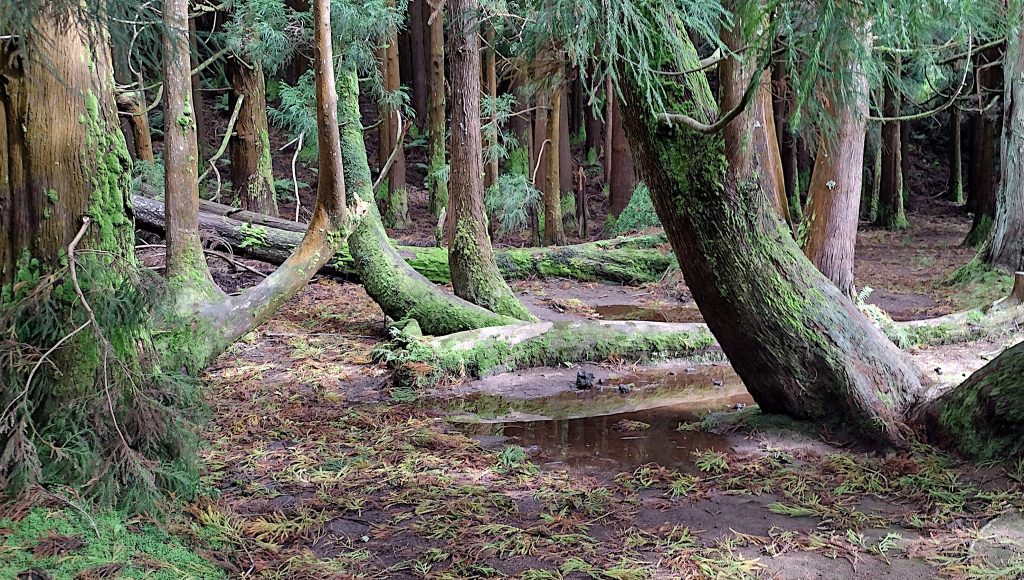
The last time you walked or sat in a forest – what made for that profound peace? A sense of relief, perhaps, the trees being so present, that it’s not all about you? The secret music in the wind’s interplay with the branches and leaves, nature singing, powerful yet intimate?
Paul Klee, 20th century Swiss-German painter, saw it this way: ‘In a forest I have felt, many times over, that it was not I who looked at the forest. Some days I have felt that the trees were looking at me …’
Reading this was an ‘Ah’ moment for me.
I try to spend a few minutes in silence each day, just contemplating the quiet, the natural world, and the vastness of everything we don’t know or understand. You’ll have picked up by now that I think there’s Someone there who is Infinite Love, and yes, I’m kind of showing up to pay my respects.
What Klee’s observation turned around for me was that it may not be I who am doing the contemplating. What if Love is watching me?
The artist’s insight nudged a memory. The poet TS Eliot had a similar thought in a garden, ‘for the roses / Had the look of flowers that are looked at’ (‘Burnt Norton’, the first of his ‘Four Quartets’). Eliot in turn drew on an early 18th century philosopher called George Berkeley – a nice priest and bishop in the Church of Ireland, good to Protestants and Catholics alike, he also tried, if unsuccessfully, to found a college in Bermuda for European settlers and Native Americans to study together – who proposed: ‘Esse est percipi’, ‘To be is to be perceived’.
Meaning, nothing exists, is real, unless it is seen, sensed, known. This needn’t be by a human mind – the Divine was in Berkeley’s reckoning, providing the continuity holding up the world so it doesn’t disappear when we humans aren’t looking! The flaw for his critics, that this pushes philosophical reasoning into the realm of faith; OK for Eliot, but not for everyone …
But to me it means something more. My next step, surely, if reality comprises a see-er and a seen, must be that nothing exists outside of relationship. Interaction defines us.
So, is the other side of the two-way mirror, once your, and my, existence is established, courtesy of God or our neighbour, that our own act of looking, paying attention, taking notice, makes a difference? How?
In his poem ‘Rumi’, contemporary American poet, novelist, and professor, Joseph Fasano, asks the question in an imaginary conversation with the 13th century Persian Sufi mystic, what can he do if he can’t effect change – and the sage’s answer, pointing ‘to the graves’, is ‘witness it’.
Aubry Tourvel, the protagonist in Douglas Westerbeke’s 2024 debut novel, A Short Walk Through A Wide World, who as a child develops a mystery illness that causes her to bleed if she stays in one place too long, eventually recognises that the purpose of her endless wandering is to be a witness to people’s lives, hidden from sight, that might otherwise remain lost forever, as if they had never been or happened.
Selective attention, possibly, but this idea keeps cropping up everywhere for me right now. Even an Instagram post reminds me: it’s our mindful presence shapes young children into confident adults, not our anxiety-inducing praise.
Then there’s the late John O’Donohue, Irish poet, philosopher, and priest, for us bereaved – anyone not? – to consider: if he’s right, ‘our friends among the dead … behold us’ (To Bless The Space Between Us, US edition, or Benedictus, UK). Though the signs are faint and infrequent, I’m with the consoled.
Craving the tangible, I circle back … to those trees, present, watching. There’s a book – Peter Wohlleben’s The Hidden Life of Trees – I suspect may explain, without explaining away, Klee’s feeling. Meanwhile, I ask, what is the forest intimation of, for me?
That none of us can exist, alone. But we can all find a context where we feel ‘seen’. And that perceiving is in all our gift.
Thank you for seeing me, in this blog post. I see you too.