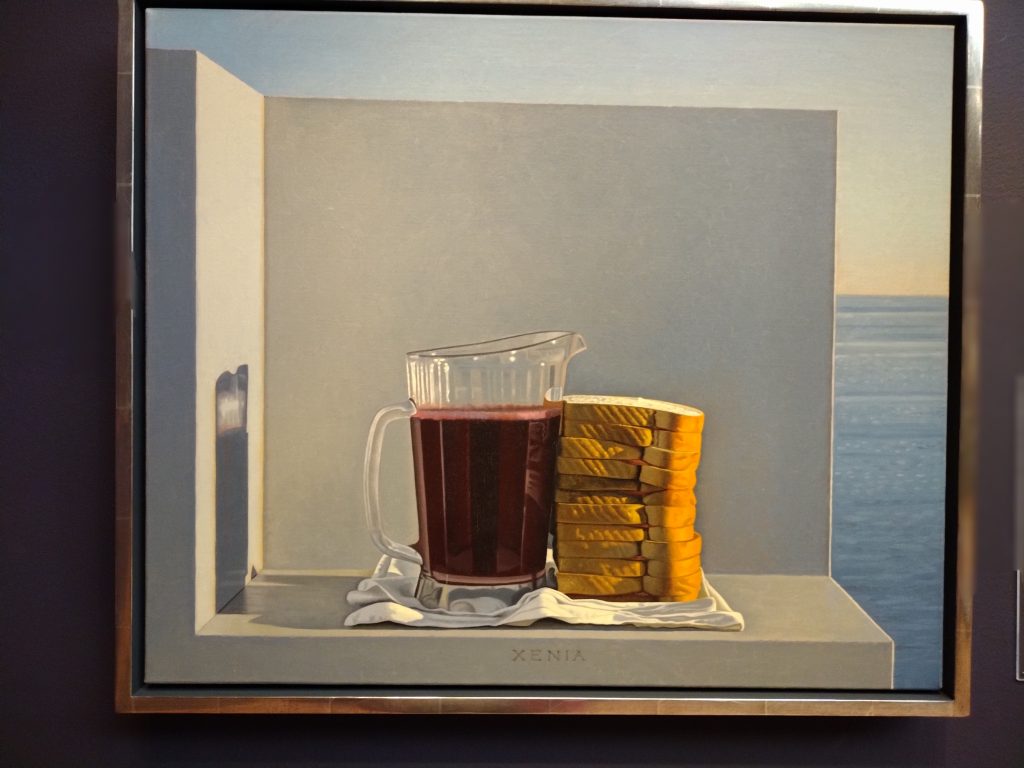
‘Still Life with Grape Juice and Sandwiches’ (1994) is a painting by David Ligare (b. 1945), who used to serve the same when he volunteered at a homeless shelter. It hangs in the de Young Museum, in the Golden Gate Park, San Francisco, California.
June’s gifts: the abrupt arrival of the Azorean summer – and clarity for my writing.
And while writing is what this post is ostensibly about, as usual I find myself learning something humanly essential from the enquiry.
I’m grateful to you generous blog followers for encouraging me to keep going with my two novel manuscripts. This month I also benefited from the insights of two industry professionals – one a book coach and literary agent, the other an indie publisher of fiction.
The most telling piece of advice I received from the book coach/literary agent for the first manuscript was to close the narrative distance between the main character and the reader with a shift in the structure of how the story is told. I intend to turn this around, and when I’ve finished the second novel manuscript I’m currently immersed in, I’ll return to my work of two years ago and do a fifth draft along these lines.
It is liberating to hear what isn’t working – why I haven’t yet got over the line for publication. Far from being disappointed, I’m relieved nobody has allowed me to release a book that both falls short and is effectively unfinished.
The second suggestion, from a successful young publisher who took the trouble to respond with feedback, has prompted me to engage in some wider-ranging reflection. Again, this was for my first novel manuscript, which I described, when I submitted it, as ‘a historical novel with a pinch of magical realism, and a love story’. I had, at the time, some misgivings about the length and complexity of this definition: a writer friend warned me when I went on submission that my book ‘must fit into a genre, not be a special snowflake’! She was astute. The publisher’s verdict was that my writing and book ‘showed great potential for publication’ but wasn’t ‘ready’ – because I needed to position myself more firmly for the market.
Which brings me to the heart of the theme I’m interrogating here – ‘the market’: what it comprises, what it represents.
Could there be some truth in another friend’s observation, that the book scene is analogous to the trend towards the generic he perceives in contemporary music? Standing by The Beatles, Pink Floyd, Sting, he laments the loss of ‘real musicians and musicianship’ in today’s pop culture. He asks, can a writer as original as JRR Tolkien once was – I’m quick to point out, I’m not! – hope to be published in 2026?
I’ve had to work out my own answer, but I’m now sure of my ground. I’m not going to be a person who complains that I can’t get my foot in the door. Who blames others’ – professionals’, or the public’s – poor taste for not leaping joyfully upon my work.
I write, not for fame and fortune, but to communicate – my ideas, dreams, imaginings.
So, for the word ‘market’, I prefer to substitute – ‘community’.
The reality is, I am wasting my time, energy, and sheer joy in storytelling, if I can’t also reach people. Unless my humanity can touch theirs – connect – what I have to offer will, quite rightly, fall by the wayside. The last thing I can afford to do is to despise ‘the market’.
As the American Presbyterian theologian and minister, also novelist and Pulitzer Prize finalist, Frederick Buechner (1926-2022), put it: ‘The place God calls you to is the place where your deep gladness and the world’s deep hunger meet.’
We’re not talking ‘bread and circuses’ here. My humanity and, out there, my community, are calling to one another – and at the nexus where my to-be-finished novels intersect with my future readers’ deepest human needs, only there will publication be earned.
Next steps? Here’s to my greater understanding of other people: valuable for living, as well as selling books.
And to each successive – and, one day, publishable – manuscript draft.


Leave a Reply